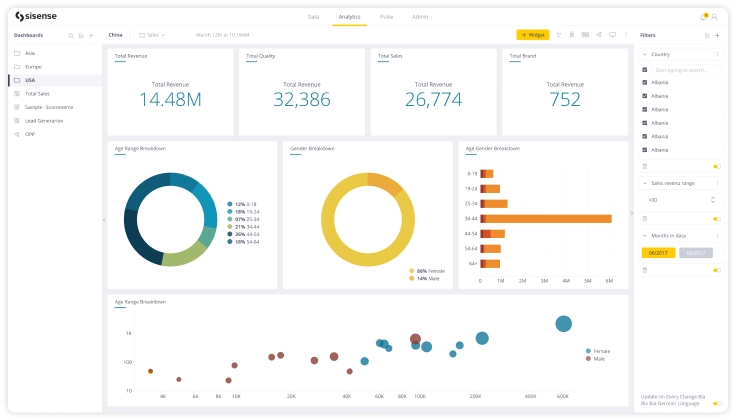
Big Database Analytics and Reporting
Working with large databases has never been easier!
Performing analysis and creating reports has always been a challenge when the required data is stored in a very big database. Many technologies have been trying to simplify this challenge, in several ways such as:
- Proprietary hardware: Custom-built and expensive servers that were designed particularly to handle big amounts of data.
- Server farms and database clusters: Harnessing multiple computers to gain more processing power, yet significant complicate architecture and maintenance.
- In-Memory technology: Loading data into memory to eliminate slow disk operations, while compromising on the amounts of accessible data and requiring expensive hardware.
ElastiCube - The Latest in Big Database Technology.
While some products and technologies (such as In-Memory BI) have been getting some attention lately, it’s a little known fact that the type of in-memory technology they use has been in existence for over 20 years. The fundamental benefit for loading datasets into memory is response time, but you pay a significant penalty in terms of scalability (amounts of data and/or number of users).
New technology - ElastiCube - was designed specifically to easily handle big databases, while using off-the-shelf hardware! No need for proprietary hardware, no maintaining of complicated clusters and no data size limitations such as imposed by In-Memory BI technology.
Big Database Analytics - Watch ElastiCube in Action!
To see a real life example of how ElastiCube technology handles big databases, watch the following video. This video shows a business user using SiSense Prism to build a report over a very large operational database containing 13 tables, the largest of which hold 100 million and 40 million rows. While databases of this size were once rare - now, any company who has a properly tracked website quickly accumulates very large data sets. The computer holding the dataset is a $1200 off-the-shelf PC with 6GB of RAM, 100GB of disk space and a single quad-core CPU (64-bit).