
The semantic harness: How leaders govern AI in production

- Blog
- AI analytics fundamentals and trends
- What is a semantic harness?
- Sisense has been building the ingredients for a semantic harness for years
- Most AI systems focus on generating a better answer. Sisense is focused on verifying it.
- Don't make AI rediscover an answer you've already verified
- Give AI your business context before it has to guess
- Security: Keep governance intact when AI becomes the interface
- One harness, every surface
- The payoff: Ship AI your customers can rely on
Product and engineering teams are under pressure to put AI into the products they build. But there’s a framing problem hiding in most AI analytics strategies: everyone is competing on the wrong 10%.
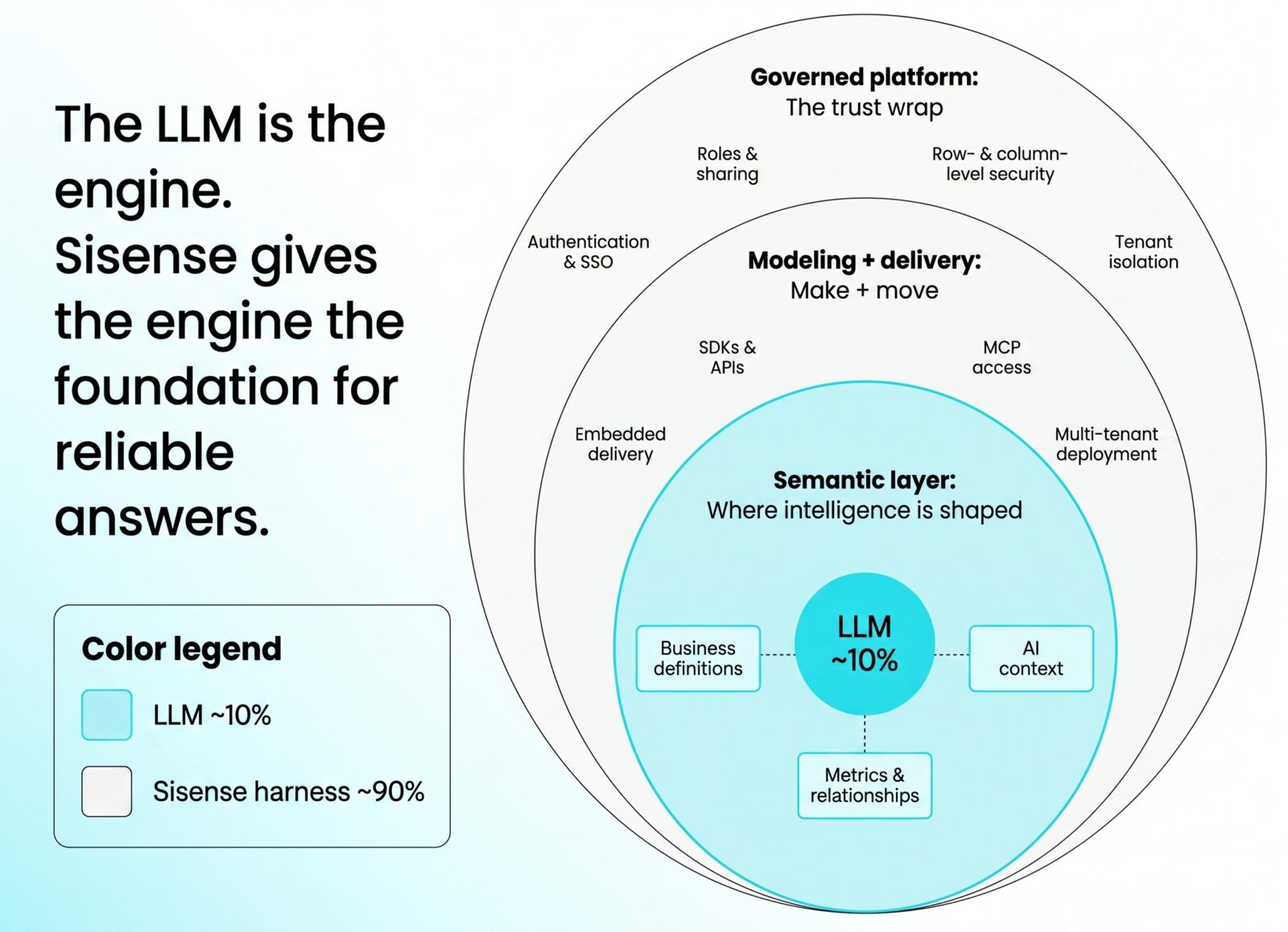
The model, which is the LLM itself, accounts for roughly 10% of what makes AI analytics work in production. The other 90% is the system around it: the tools, context, guardrails, governance, and verification that determine whether the answer it generates is one you can stand behind.
According to LangChain, changing only the harness around a model, with no model changes, moved an agent from outside the top 30 to the top 5 on public benchmarks.
Most vendors are racing to tune the engine. The harness is what actually wins. Sisense offers a managed LLM and supports BYO LLM, and we’ve focused on the harness: the 90% that produces reliable answers.
Because our customers’ AI interacts directly with their customers, and generating an answer isn’t enough.
For example, an AI model can misunderstand what your business means by “revenue.” Is it booked or recognized, gross or net? You can apply the wrong analytical logic and still produce a polished response that looks credible. The customer sees the answer, not the faulty assumptions behind it. We’ll come back to revenue. It’s a useful example of how invisible those distinctions can be.
For product leaders, that’s a brand and customer trust problem. For engineering, it creates a new challenge: how do you provide the context, controls, and governance required to move AI safely into production? And for data leaders, the definitions and governance they’ve spent years establishing cannot disappear because an LLM becomes the new interface.
What is a semantic harness?
This is where the semantic harness comes in. The model provides reasoning and generative capabilities. The semantic harness is the system around it that supplies business meaning, analytical rules, governance, and verification.
The hardest problem is building the system around the model that determines what it should trust, and whether the analytics it produces are right.
Sisense has been building the ingredients for a semantic harness for years
A semantic harness may be a new frame for AI analytics, but its ingredients already exist in Sisense.
For years, Sisense has worked between complex business data and the people who need to act on it. The platform already contains assets AI needs to operate reliably: a semantic layer that captures business meaning and relationships; governed metrics; row-level security and tenant context; and analytics people have already built and trusted.
AI changes the value of those assets, which now serve a second purpose: context, constraints, and evidence for AI.
Instead of letting an LLM create a parallel interpretation of the business, those definitions can shape how AI understands the business.
Engineering teams don’t have to approach AI as an entirely new analytics infrastructure problem. Putting an LLM into a prototype is one thing. Building the semantic context, permissions, tenant isolation, and analytical safeguards required for a customer-facing production experience is another.
That’s the Sisense starting point: putting years of governed analytics knowledge to work for AI.
Most AI systems focus on generating a better answer. Sisense is focused on verifying it.
Much of the work around AI accuracy focuses on improving what goes into the model. Give it richer context. Ground it in a semantic layer. Add guardrails.
But they still leave an important question unanswered: How do you know the analysis it produces is actually correct?
Sisense addresses that challenge by bringing together three things:
- Semantics: What does the business mean?
- Governance: What is this user allowed to know?
- Verified analytics: What does the organization already know to be correct?
The first two are available today. The third is where the equation changes.
Semantics and governance: Available now
The Sisense semantic harness already combines a governed semantic layer with row-level security and tenant context, giving AI the business meaning and access controls that governed analytics requires.
Verified analytics: Coming in 2026.4.1
Organizations have spent years building dashboards, defining metrics, approving analytical logic, and validating questions about their data. Collectively, those assets capture decisions about how the organization expects its data to be interpreted.
Verified analytics puts that knowledge to work for AI. Instead of only supplying an LLM with better context and trusting it to reach the right conclusion, known-good analytics provide reference points for evaluating its behavior. The system doesn’t have to treat every prompt as if it’s encountering the business for the first time.
This capability is coming in November with the 2026.4.1 release.
Grounding vs. verification
Grounding gives the model a better basis for reaching the right answer. Verification asks whether the model’s analytical behavior aligns with what the organization has already established as correct.
The Sisense semantic harness advantage is the combination of all three: semantics, governance, and verified analytics. The first two are ready now. The third is coming soon.
Don’t make AI rediscover an answer you’ve already verified
Verification also changes what happens when someone asks AI a question. If your organization has already established the right way to answer it, why ask an LLM to reconstruct the analysis from scratch every time?
Give AI your business context before it has to guess
Not every question maps to a verified answer. That’s when the semantic foundation becomes critical.
A database schema can tell an AI that a field is called “revenue.” It can’t tell it whether that means booked or recognized, gross or net, how refunds should be treated, or which date determines the reporting period. Those distinctions can completely change the answer, yet they’re invisible in the raw data. Business definitions, relationships, governed metrics, and semantic context give AI information about what the data means, not simply where it lives.
For data leaders, this preserves consistency as people use analytics in different ways. In other words, a KPI shouldn’t mean one thing in a dashboard and something different when someone asks AI about it.
For product teams, that consistency shows up directly in the customer experience: not a generic chatbot with database access, but an AI that understands the business context behind the questions customers ask.
Security: Keep governance intact when AI becomes the interface
In customer-facing AI, the right answer has to be the right answer for that user. Getting the analysis right is only one part of trust. There’s another question the system has to answer every time: Should this user have access to that answer in the first place?
That’s especially important in multi-tenant applications. An answer can be analytically correct and still be a serious failure if it contains information the person asking isn’t authorized to see.
Governance has to remain attached to the answer. Row-level security and tenant context determine which data can contribute to an answer for a particular user.
For engineering teams, that means adding AI doesn’t turn security and tenant isolation into a separate infrastructure project. Existing analytics controls can continue to protect data as users begin interacting with it through conversational and agentic experiences.
For product teams, it helps remove the false choice between moving quickly on AI and maintaining the standards required for the product. And for data leaders, established controls remain as new interfaces emerge.
One harness, every surface
More and more AI answers won’t be read inside an analytics tool. They’ll show up in your product, inside a customer’s app, or in an agent someone else built.
You don’t need a separate harness in each of those places. The harness stays in Sisense. Every question, wherever it starts, is answered through it, and only the answer goes back out.
The question can come from:
- The Sisense Intelligence assistant
- An experience your team embeds with Compose SDK
- An external AI agent connecting over MCP
MCP is the most interesting case. An agent someone else built can ask Sisense a question, and Sisense answers it inside the harness, under the signed-in user’s own permissions. The agent gets back the same governed answer that the user would see in the product, the same definition of revenue, scoped to their tenant and the specific rows they’re allowed to see. The agent never has to know how revenue is defined.
That changes what it takes to add AI to a product. You define meaning and access once, in one place, and every surface gets answers that went through it, including agents you didn’t build.
The payoff: Ship AI your customers can rely on
With the semantic harness, all your teams move faster on AI without lowering the standard for what reaches customers.
For product leaders, the semantic harness is ultimately about shipping differentiated AI without making customer trust collateral damage. AI can become part of the product while operating from the business definitions and analytics customers already depend on.
For engineering leaders, it’s about moving faster without building an entire semantic, security, tenancy, analytics, and verification stack around an LLM. The model takes its place as one component of a production system, governed and constrained by everything around it.
For data leaders, it means the years spent defining metrics, governing access, and building trusted analytics don’t disappear when AI becomes the interface. They become part of the architecture that helps constrain and verify it.
Ready to put a semantic harness around your AI? Book a demo.


Subscribe to the Sisense newsletter
Get monthly insights on building smarter products with AI-powered analytics, from industry trends to real Sisense use cases.