
Embedded analytics requirements: What to consider before choosing a platform

- Blog
- Embedded Analytics
- Align product and business needs with embedded analytics requirements
- Core technical requirements for embedded analytics
- UX and integration requirements
- Governance, operations, and vendor requirements
- Building your embedded analytics evaluation checklist
- How Sisense excels at embedded analytics requirements
Landing on the right embedded analytics platform for your organization is more than a feature decision. It’s a strategic product and infrastructure investment.
The platform you choose impacts everything from end-user experience and developer workflows to foundational aspects of your product like scalability and security—as well as the revenue opportunities embedded analytics can unlock.
This guide walks you through all the facets to consider, so you can pinpoint the embedded analytics requirements you need to shape long-term product success.
Evaluating embedded analytics platforms? Start here
The ultimate guide to comparing embedded analytics solutions.
Read guide
Align product and business needs with embedded analytics requirements
First things first: why are you building embedded analytics into your product?
Start with a clear, big-picture strategy: your business goals, product vision, and the end-user experience you want to create. Solidify those decisions first; the technical details of your embedded analytics requirements checklist will flow logically from them.
Successful implementations begin with a clear understanding of who the analytics experience is for, what those end-users want to accomplish, and how embedded analytics support your broader product vision.
Who are you building for?
Consider the people who will interact with your embedded analytics. Each individual (including various end-users among your customers as well as internal users at your company) has unique needs.
Look for a platform with embedded analytics features that serve a range of user scenarios:
- Operational end-users want intuitive dashboards, self-service reporting, and granular data exploration to support their daily work.
- Administrator-level end-users require a higher level of visibility into usage, operational metrics, and account-level configuration
- Executive end-users seek rapid access to high-level insights and trend snapshots to guide data-driven decision-making at the organization level.
- End-users in regulated industries need solutions that adhere to the security and compliance standards governing their operations.
- Internal partners who leverage your analytics solution for a variety of applications: sales and marketing teams gathering internal business intelligence, decision-makers setting product and business strategy, and non-technical users creating analytics for internal or customer use.
Embedded analytics platform requirements vary significantly depending on whether your primary goal is to serve end-users, internal needs, or both:
- Both customer-facing and internal analytics: One of the greatest benefits of embedded analytics for software creators is the dual benefit of end-user features plus internal use cases. An ideal embedded analytics platform equips you to integrate robust in-app experiences as well as internal analytics without having to build separate solutions.
- External-facing analytics: Embedded analytics for SaaS or other software products bring customer data directly into your product for end-user experiences. You’ll need features like extensive customization and white labeling, support for a broad range of compliance standards, and flexible methods for building and embedding.
- Internal analytics: Weaving analytics experiences into your organization’s workflows calls for a platform that prioritizes capabilities like multisource reporting, customized dashboards for different roles, and native connections to the business tools you already use.
Build a better experience with embedded analytics: The product manager’s guide
Get your guide
Use cases and user journeys
Once you understand your audiences, the next step is to map them to embedded analytics workflows and user journeys. What do end-users want to accomplish as they navigate analytics within your application?
Building based on real end-user journeys helps teams create analytics experiences that feel like a natural part of your application, not bolted on afterward. And when you design with real-world use cases in mind, you can easily identify which embedded analytics capabilities will drive meaningful product and business value.
Consider critical embedded analytics use cases like:
- Dynamic, interactive dashboards and visualizations
- Self-service analytics for ad hoc exploration
- Scheduled report generation
- Real-time alerts and in-app notifications
- AI-powered data exploration and insights
- Integration workflows in operational applications
These use cases directly shape your embedded analytics platform requirements. They determine the platform features, technical capabilities, and integrations you need to serve your larger purposes. For instance, operational use cases might focus on APIs and composable components, while self-service exploration calls for emphasis on AI-powered insights and natural language querying.
The big book of embedded analytics use cases
Real-world examples and impacts across four industries.
Read whitepaper
Core technical requirements for embedded analytics
You’ve laid out the who, what, and why. Now it’s time to get into the how: the technical details for your embedded analytics evaluation checklist. The platform’s architecture should support modern data environments and deliver consistent performance at scale while maintaining compliance with security and regulatory requirements.
Data connectivity and modeling
Embedded analytics experiences are only as strong as the data ecosystem they draw from. Your chosen platform must integrate seamlessly with the data infrastructure your organization already uses: connecting every data source, supporting flexible modeling, and simplifying governance across environments.
Data stack compatibility
Software creators need compatibility with modern cloud architectures, including warehouses, lakehouses, and distributed environments. Direct integration with top enterprise data platforms—Snowflake, Amazon Redshift, Google BigQuery, Azure Synapse—is a must-have embedded analytics requirement.
Beyond cloud architecture integration, be sure you choose a platform that seamlessly integrates with every other data source in your stack, including third-party apps. If you use any on-prem systems, pay particular attention to how the platform enables integration. Many embedded analytics tools are really designed for either cloud or on-prem connections; the most scalable options are built to support both equally well.
Semantic modeling
At the semantic layer, software creators need consistent business logic, metrics, and governance rules. This creates a more reliable embedded analytics experience across applications and workflows. That reliability reduces the risk of duplication, improves trust in analytics, and enables more scalable self-service experiences. A mismatch in the semantic model can be difficult to overcome later, so consider it a fundamental embedded analytics requirement from the start.
Performance and scalability
Once your data foundation is in place, the next step is delivering an analytics experience that performs at scale. What you build now must maintain optimal performance as your data volume and customer base grows, without requiring a major overhaul down the road.
Operational infrastructure
End-users have higher expectations for embedded analytics than for traditional internal BI tools. Your customers assume that embedded analytics will respond instantly and process data in real time.
Key considerations for embedded analytics platform requirements:
- Overall reliability and operational readiness
- Scalability frameworks
- Autoscaling capabilities
- Performance monitoring tools
- Uptime guarantees
- Real-time data processing
- Service-level agreements (SLAs)
Speaking of SLAs: be sure to choose a platform whose performance guarantees align with the promises you make to your customers—especially if you have any client-specific SLAs to support.
Together, these capabilities maintain a consistent customer experience as adoption grows and usage patterns evolve.
Multi-tenant architecture support
For embedded analytics in multi-tenant environments, performance and scalability requirements become more complex. An optimal platform ensures stability in the face of growing tenant counts and data volumes.
Key considerations for multi-tenant embedded analytics platform requirements:
- High query concurrency across tenants
- Intelligent caching and query optimization
- Adaptive resource management
- Elastic scaling capabilities
- Real-time or near-real-time data delivery
- Resource isolation between tenants
- Consistent dashboard and in-app analytics performance at scale
Embedded analytics: 5 success stories from tech industry innovators
Read whitepaper
Security and compliance
Embedded analytics require software makers to bring an extra level of attention to security and compliance. When you bring customer-facing data into your application, you also bring more security risks. So your embedded analytics evaluation checklist should treat iron-clad security features as non-negotiable.
The right platform makes it easy for you to deliver highly secure embedded analytics at scale while limiting operational complexity. The platform owns infrastructure security, certifications, and platform maintenance. You’re then responsible for configuring permissions, data access policies, and governance rules.
Key security considerations for embedded analytics platform requirements:
- Role-based access controls (RBAC): Restrict access to analytics features, dashboards, and data based on each end-user’s role, ensuring people only see what they need.
- Row-level security (RLS): Automatically limit data visibility at the record level so each end-user only sees the specific data they’re authorized to access.
- Secure single sign-on (SSO): Simplify authentication and strengthen security by allowing end-users to access embedded analytics through a trusted identity provider.
- Encryption in transit and at rest: Protect sensitive data from unauthorized access by encrypting information both while it’s being transmitted and while it’s stored.
- Audit logging and monitoring: Track end-user activity, access events, and system changes to support security investigations, compliance requirements, and anomaly detection.
- Tenant-aware governance controls: Maintain strong data isolation and policy enforcement across customers, ensuring secure multi-tenant analytics environments.
- Privacy and information security frameworks: Adhere to top frameworks for data security and privacy, including ISO 27701 and SOC 2 Type 2.
- Industry and regional regulation compliance: If you’re in a highly regulated industry or serve customers in certain regions, leverage a platform that conforms to governing laws like HIPAA, GDPR, and CCPA.
Secure your data without sacrificing user experience
Learn how Mytonomy balanced strict data security with seamless experiences using Sisense.
Watch webinar
UX and integration requirements
Technical capabilities are just one part of the embedded analytics requirements to consider. The actual experience of using analytics is just as vital—for both end-users and software creators.
Native UX look and feel
Your in-app analytics should feel like a natural part of your product experience, not a separate tool inserted into the application.
Most embedded analytics platforms allow you to customize superficial UI elements like colors and fonts to match your branding. But the end-user experience is governed by more than how features look. To really feel like a native part of your application, embedded analytics should reflect the overall design systems, navigation patterns, and workflows in your product.
To achieve harmony with your application’s UX, rely on a platform that gives you extensive customization and control over how your embedded analytics both look and function.
Key embedded analytics platform requirements:
- Flexible theming for dashboards and visualizations
- Control over layouts, navigation, and component styling
- Customizable pre-built widgets and filters
- Composable analytics for building custom components
- Responsive cross-device design support
There are a variety of embedding patterns to achieve a customized UX. For the most flexibility, use an embedded analytics platform that supports multiple options:
- Iframe-based embedding for faster implementation
- JavaScript SDKs and APIs for deeper customization
- Component-level integration for precise integration of custom elements
While iframe approaches are effective for simple use cases, modern SaaS products benefit from composable analytics toolkits, giving software creators granular control over the entire experience.
Developer experience and tools
Embedded analytics promise a seamless experience for your end-users. Building those experiences should also be seamless for developer teams. Look for a platform where they can work efficiently: creating, embedding, and scaling as you extend features and functionality.
Foundational embedded analytics platform requirements for the developer experience:
- Flexible APIs, including REST and JavaScript APIs
- Robust SDKs, including frontend and backend SDKs
- Extensibility, including custom widgets, actions, and plugins
- Automations, including for infrastructure, deployment, and maintenance
- Extensive documentation, including versioning and changelogs
You need a platform that empowers dev teams to build, embed, automate, and extend analytics capabilities without introducing unnecessary complexity. A flexible platform equips you with multiple approaches you can leverage to suit your needs at any given stage of development:
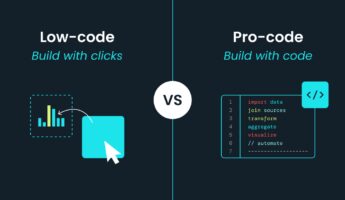
- No-code: Accessible tools—like drag-and-drop interfaces and generative AI building—enable you to rapidly prototype and deploy core functionality. Non-technical users can easily build analytics for internal BI use.
- Low-code: With minimal coding, you can spin up and customize every aspect of your analytics experience. Ideal for ramping up time-to-market and reducing the load on development resources.
- Pro-code: Advanced capabilities empower you to build dynamic components and functionality directly, within the analytics platform or directly from your application code.
The best platforms balance developer flexibility with usability, enabling you to build customized analytics experiences without creating bottlenecks for engineering resources.
Build analytics that flex with your product roadmap
See the powerful potential of composable analytics.
Read more
AI-powered data exploration and analytics creation
AI analytics tap into the power of machine learning to simplify the process of extracting meaningful insights from raw data—and embedding those insights into your application. That transforms the experience for end-users and software creators alike.
AI-powered embedded analytics requirements: End-user experience
When you launch in-app analytics, they make your product more valuable to customers—but only if they actually use them. Generative AI features drive analytics adoption by making data exploration accessible and surfacing insights intuitively.
Partner with an embedded analytics provider that offers key features like:
- Natural language querying (NLQ): Enable end-users to ask questions in plain language and instantly receive answers, visualizations, or insights without writing SQL or navigating complex dashboards.
- Natural language generation (NLG): Automatically translate complex data into clear, human-readable explanations that help end-users understand trends, anomalies, and performance drivers.
- AI predictive analytics: Use machine learning to forecast future outcomes, identify risks and opportunities, and help end-users make more proactive decisions.
- Automated insights and alerts: Proactively surface significant changes, emerging trends, and anomalies so end-users can take action without constantly monitoring dashboards.
AI-powered embedded analytics requirements: Software creator experience
Generative AI doesn’t just improve the analytics experience for end-users. An AI-powered embedded analytics platform also helps developers build, customize, and deploy embedded analytics faster.
Look for a platform that includes AI-powered development capabilities such as:
- Conversational building with NLQ: Enable developers and product teams to create analytics experiences using natural language prompts instead of manually configuring dashboards, queries, and workflows.
- Automated data modeling: Automate data preparation, relationship mapping, and model creation to reduce manual effort and accelerate development velocity.
- AI-powered dashboard and visualization creation: Generate dashboards, charts, and reports from natural language prompts to move from idea to implementation in minutes.
- LLM flexibility: Support integration with leading large language models (LLMs) and AI providers, giving organizations the freedom to align AI capabilities with their security, compliance, and performance requirements.
Sisense Intelligence, built exactly for this, is a unified suite of AI capabilities built natively into the Sisense platform, covering the full spectrum of what both end-users and software creators need from AI-powered embedded analytics.
The Sisense Intelligence assistant enables natural language querying and conversational data exploration directly within your application. narrative automatically generates plain-language summaries alongside visualizations, making insights accessible to non-technical end-users. forecast uses machine learning to surface predictive analytics and forward-looking trends. And for developers, Sisense Intelligence accelerates the build process itself, with AI-assisted data modeling, dashboard creation, and embedding through natural language prompts.
Critically, these capabilities are not add-ons layered on top of a traditional BI platform. They are native to the analytics engine, which means faster performance, more accurate responses, and a coherent experience for end-users and builders alike. LLM flexibility is built in: choose a fully managed Sisense LLM for instant setup with no infrastructure to maintain, or bring your own LLM through supported providers to meet your compliance and cost requirements. Both options can coexist on the same deployment.
Get ready: How AI-powered analytics will reshape decision-making by 2027
Download report
Governance, operations, and vendor requirements
The final embedded analytics requirements are all about the operational realities of implementing a solution at scale. Governance, administration, and commercial alignment all play a major role in long-term success—especially for SaaS companies serving multiple customers and environments.
Governance and administration
Modern SaaS teams need to scale embedded analytics responsibly, which requires operational controls that support multi-tenant environments, controlled deployments, and scalable administration practices. These controls have to scale, adapt, and remain flexible as your operational complexity grows.
Key embedded analytics platform requirements:
- Centralized multi-tenant management
- Separation across development, testing, and production environments
- Role and permissions management
- Content promotion and version control workflows
- Monitoring, auditing, and operational visibility
Change management becomes especially important when analytics deployments need to align with your broader product release cycles. That’s why it’s critical to understand where governance responsibilities are shared between the platform vendor and your organization.
|
Platform vendor
|
Software company
|
As you research embedded analytics platforms, clearly define operational ownership early in your evaluation process. If a platform doesn’t meet your administration and security standards, it won’t be a good fit. Your responsibilities (the software company side of the table) can be built into your embedded analytics rollout. The maintenance of these policies sits with your team.
Clarifying these operational boundaries early helps you avoid governance gaps and better aligns internal ownership across teams.
Pricing, licensing, and white labeling considerations
Think back to that initial question: why are embedded analytics on your product roadmap in the first place? At the end of the day, it serves a business goal: a competitive edge, deeper customer engagement, and improved revenue opportunities. The platform you use has a direct impact on those goals.
The question of commercial scalability matters just as much as technical scalability. The most effective embedded analytics platforms align both technically and commercially with how software companies build, sell, and scale products.
The requirements to put on your embedded analytics evaluation checklist depend on your particular stage of growth and business needs. Consider these factors as you assess options:
- Pricing model (seat-based vs. usage-based): Evaluate how pricing scales with your business model. Seat-based licensing can become cost-prohibitive for customer-facing analytics, while usage-based models often provide greater flexibility.
- Customer growth expectations: Ensure pricing remains predictable and cost-effective as your user base, data volume, and analytics adoption grow.
- Platform packaging strategy: Choose a licensing model that supports how you package and distribute embedded analytics across different products, tiers, and customer segments.
- Margin requirements: Understand how analytics costs scale over time to protect profitability and avoid unexpected increases as usage expands.
- OEM and white label analytics: Use a platform that empowers you to fully brand the entire analytics experience as your own, package analytics as premium features, and create standalone white-labeled offerings.
- Multi-tenant deployment models: Confirm that licensing and architecture support serving multiple tenants efficiently and economically from a single deployment.
- Contract and pricing flexibility: Look for pricing structures that can adapt as your product evolves, whether you expand into new markets, launch new offerings, or introduce AI-powered analytics features.
Drive revenue with embedded analytics
Key strategies to unlock the full potential of your analytics tools
Watch on-demand webinar
Building your embedded analytics evaluation checklist
Sorting through embedded analytics platform options can quickly get overwhelming. You need to find a platform that aligns with your needs across multiple dimensions.
Simplify the process with an embedded analytics evaluation checklist: a vendor comparison matrix that directly compares your needs with each platform’s corresponding capabilities.
Top criteria to include on your embedded analytics requirements checklist:
- Product and business requirements
- End-user personas and analytics workflows
- Self-service analytics experiences
- AI-powered and operational analytics needs
- Core technical requirements
- Data connectivity and semantic modeling
- Scalability and multi-tenant performance
- Security and compliance controls
- UX and integration requirements
- Extensive UI and UX customization
- APIs, SDKs, and composable architectures
- No-code, low-code, and pro-code flexibility
- Governance and operational requirements
- Environment management and deployment workflows
- Administrative controls and auditability
- Vendor support, reliability, and compliance ownership
- Commercial and go-to-market alignment
- Pricing and licensing models
- Packaging flexibility and monetization options
- Long-term scalability of operational costs
How you weigh each category depends on your application’s existing architecture and your business priorities. Once you’ve fleshed out an embedded analytics evaluation checklist specific to your scenario, you can go into demos and free trials with a clear methodology for determining how well a platform aligns with your real-world product, engineering, and business requirements.
Watch the road: 4 pitfalls to avoid when embedding analytics
Read whitepaper
How Sisense excels at embedded analytics requirements
Choosing an embedded analytics platform is about more than checking off technical requirements. It’s about finding a solution that helps you create differentiated product experiences, scale with confidence, and turn analytics into a competitive advantage.
Sisense is purpose-built for software companies and digital product teams, combining enterprise-grade analytics with the flexibility modern applications require.
Why organizations choose Sisense for embedded analytics:
- Designed for embedded use cases: Deliver analytics that feel like a natural part of your product with extensive customization, white labeling, and composable embedding options.
- Built to scale: Support growing data volumes, user bases, and multi-tenant environments without sacrificing performance or reliability.
- Developer-friendly by design: Accelerate development with powerful APIs, SDKs, low-code tools, and AI-powered creation experiences.
- AI-first analytics: Empower both end-users and software creators with natural language experiences, automated insights, and flexible LLM integration.
- Enterprise-ready security and governance: Meet demanding security, compliance, and operational requirements while maintaining control over data access and governance.
Ultimately, the best embedded analytics platform is the one that aligns with your product vision, technical architecture, and business model. Sisense helps organizations meet today’s embedded analytics requirements while providing the flexibility to evolve alongside future customer, product, and AI-driven innovation.



Subscribe to the Sisense newsletter
Get monthly insights on building smarter products with AI-powered analytics, from industry trends to real Sisense use cases.